QUICKLINKS
-
Want to also share kids feedback along with yours? Here are the two links to report progress:
How should we report numbers if we’re estimating?
Estimates are acceptable. Use your best judgment — exact counts are not required.
Can students self-report?
Yes. Teachers may:
Collect quick student pulse checks
Use thumbs, fingers, or quick paper tallies
Report classroom averages
What matters most in reporting?
✔ Consistency
✔ Honesty
✔ Noticing trends over timeThis data helps us:
Improve the program
Share impact with schools and funders
Advocate for student wellbeing
How often should I submit progress?
You may submit progress weekly or monthly — whatever works best for your classroom. Weekly check-ins give us the clearest picture, but flexibility is built in.
What if we don’t do Care Hard every day?
That’s completely okay. Care Hard is not a daily requirement. Many classrooms implement it daily while others do it by blocks schedules:
2–3 times per week
During Assemblies
During high-need moments (testing, transitions, behavior resets)
-
How are Care Actions counted?
Care Hard operates on an honor system. We trust educators and students to report honestly and reasonably. Perfection is not the goal — participation and consistency are.
What counts as a Care Action?
Each of the following counts as 1 Care Action per student:
Watching a Care Hard video
→ Counts as 1 action × number of students presentClass discussion answering one reflection question
→ Counts as 1 action × number of students who participatedCompleting a Care Action (movement, reflection, kindness, etc.)
→ Counts as 1 action × number of students who completed it
Do service projects count differently?
Yes — service projects earn bonus actions.
Service project participation
→ Counts as 2 Care Actions per participating student
Examples:
Care kits
Peanut butter drive
Care cards
School or community improvement projects
Do students need to complete every action?
No. Care Hard is flexible by design. Students may participate at different levels based on age, comfort, or attendance.
What if we adapt an action or combine activities?
That’s encouraged. If students:
Watch a video and discuss one question
Do an action during PE, art, advisory, or assembly
You may count each distinct engagement.
-
CARE HARD Challenge – Educator FAQ
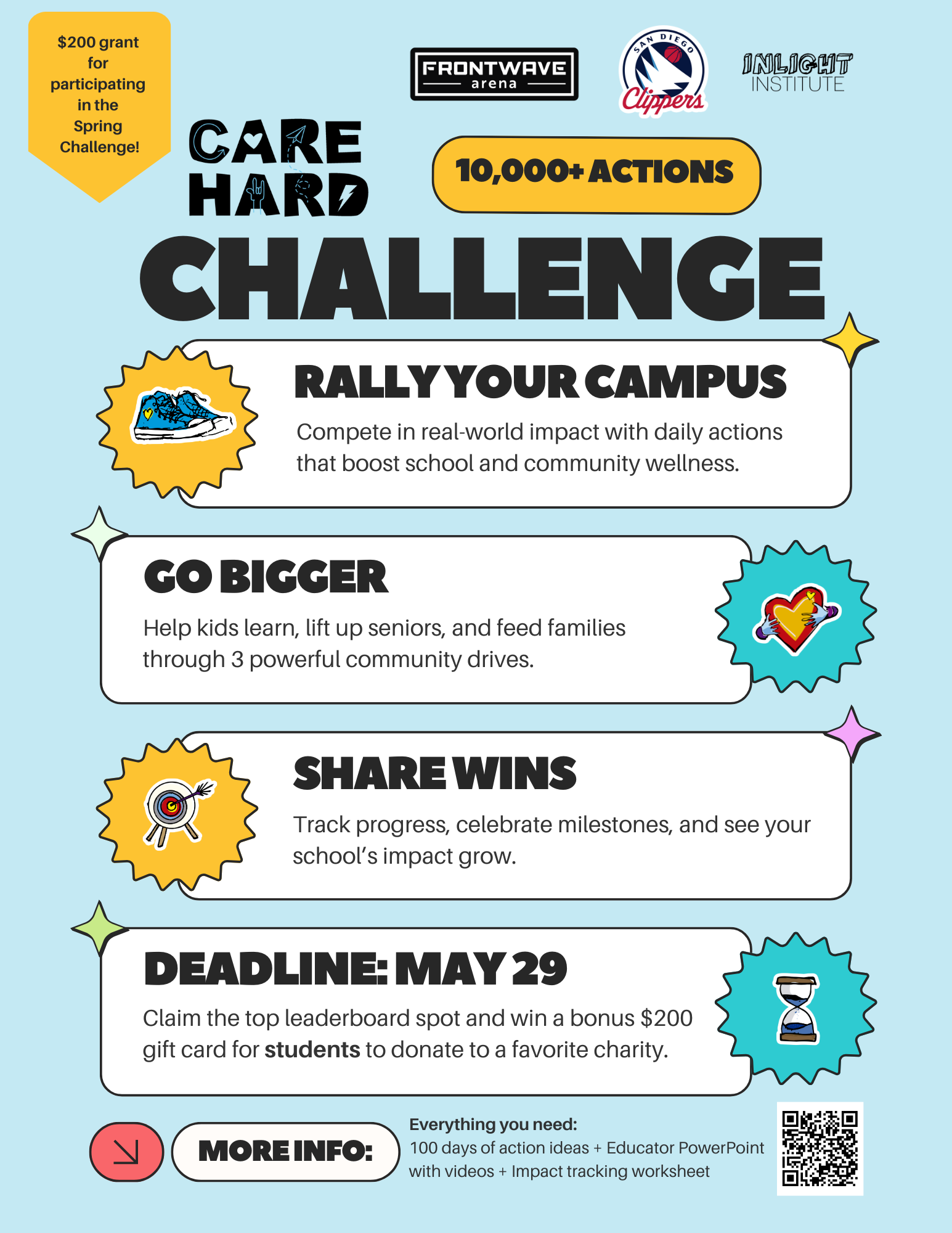
How do we receive the $200 grant money?
One adult from your school will need to create a profile at Spotlight XYZ and open a Giving Wallet. The process takes less than 5 minutes. Funds can be transferred to a school account or a personal profile. Grants are a gift to that no fee, no cost donor-advised-fund. Grants to eligible nonprofits can be made from that Wallet.
Is this a competition?
No. Care Hard is about culture change, not comparison. Milestones are for celebration, not pressure. We do celebrate one school for outstanding achievement. They receive an additional $200 grant to donate.
Who can I contact with questions or ideas?
Reach out anytime — we value feedback, adaptations, and creativity from educators. hello@inlightinstitute.org
Step 1: See below for the Classroom Edition or Assembly Edition slides for a plug-n-play program. The challenge is open from January 20-May 29, 2026.
Step 2: Download the Welcome Kit for a reference doc, email templates, and a full list of actions.
Choose Your Implementation Option
10-20 minute daily implementation
Includes 90 days of actions and script:
Guided Monthly Calendar
2-3 Minute video
2 Reflection questions per video
4 Action Wheels (35 Actions)
Skill of the month
Cause of the week
3 Guided Service Projects
Link to Additional 80 Care Actions, 52 Affirmations, 52 GRWM (Get Ready with Me) Morning tips
2-5 minute flexible implementation
Includes 45 days of actions and script:
45 days of Care Actions
4 Action Wheels (35 Actions)
Link to 3 optional Service Projects
Link to Additional 80 Care Actions, 52 Affirmations, 52 GRWM (Get Ready with Me) Morning tips
By the month






June
What to watch out for: Bullying
Why: End-of-year fatigue, less structure, and increased online/social activity raise friction.
Skill: Teamwork
Cause: Schools, Art, & Sports
Service Project: Care Fair / Donation Day
What to watch out for: Anxiety
Why: Transition out of school removes daily structure and support systems for some students.
Skill: Contribution
Cause: Food & Housing
Service Project: Summer Challenge
What to watch out for: Loneliness
Why: Valentine’s dynamics, friendship visibility, and comparison intensify feelings of being left out.
Skill: Compassion
Cause: Civic Life & Fairness
Service Project: Care Cards
What to watch out for: Self-harm
Why: Post-holiday letdown, cold/dark days, academic pressure, and disrupted routines peak.
Skill: Resilience
Cause: Health & Wellness
Service Project: N/A
What to watch out for: Burnout
Why: Motivation drops. Students feel tired but not finished, leading to shutdown or apathy.
Skill: Curiosity
Cause: Planet & Our Environment
Service Project: PB Challenge
What to watch out for: Anxiety
Why: Valentine’s dynamics, friendship visibility, and comparison intensify feelings of being left out.
Skill: Integrity
Cause: Public Safety & Community Care
Service Project: Care Kits
Download the flyer or Welcome Kit with Scripts